And What Remains in the End: The Memoirs of an Unrepentant Civil Servant by Robin Gupta
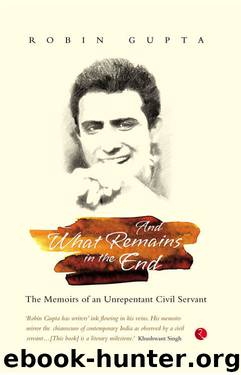
Author:Robin Gupta [Gupta, Robin]
Language: eng
Format: epub
ISBN: 9788129122919
Publisher: Rupa & Co
Published: 2013-03-29T18:30:00+00:00
I accompanied Mr P. V. Naramsimha Rao to the beautiful island of Mauritius in 1986. The minister, who was placed at second position in the Union Cabinet, was on a political mission to a nation where nearly half the population were of Indo-Mauritian descent. As India’s deputy secretary from the Union department of sports, it appeared that I was a mask for the high-powered delegation.
At Port Louis, we were received by the president of Mauritius with a host of dignitaries in attendance. I was spellbound by Narasimha Rao’s eloquent speech, which was delivered in flawless French. Thereafter, the long cavalcade of limousines drove to the Gandhi Institute, where the minister waxed eloquent in shuddh Hindi, in which the Mauritian Indians revelled, though the official language was English. Rao Sahib’s English, though spoken with a slight accent, would have, in thought, content, grammar and syntax, made a Cambridge don sit up and introspect.
We were lodged in the tastefully appointed president’s villa by the ocean. The large living area had two luxurious suites on either side, one of which was allotted to me. There, I noted the similarities between Mr Gopalaswamy and Rao Sahib. Their lifestyle was disciplined and the food they ate was frugal in the extreme. Fruits, yoghurt and cereals; chopped vegetables and rice, with rasam or sambhar. Both Mr Gopalaswamy and Naramsimha Rao were knowledgeable about the Carnatic style of classical music; both were scholars of Vedic literature; both awakened early and were deeply religious. Quite by chance, I witnessed Rao Sahib chanting the Sahastranaam, the one thousand and eight names of Lord Vishnu, as he watched the flaming sun descend into the ocean.
After Ramu Damodaran—an exceptionally brilliant foreign service officer, then posted as the minister’s private secretary and who was treated by the widower Rao Sahib as a son—had given him his medicine, the minister retired for the night. The presidential villa was situated close to a resort near the beach and I could catch the strains of rhythmic music from there. Tossing in bed, with sleep eluding me, I picked up the copy of Zorba the Greek that I was carrying with me. I felt diffident reading Zorba’s lascivious opinions about life with Rao Sahib asleep upstairs—they seemed tangential to our mission of goodwill to consolidate our hold over the minuscule nation in the Indian Ocean. ‘Man is a brute,’ says Zorba. ‘If you’re cruel to him, he respects and fears you. If you’re kind to him, he plucks your eyes out.’ I wondered if this could be the underlying principle for effective diplomatic exchange, couched in sober and carefully considered prose. There was no reprieve from the music and I continued reading. The aim of man and matter, according to Zorba, is to create joy and, according to his postulates, when the body dissolves, nothing remains of the soul. ‘And does our unquenchable desire for immortality spring from the fact that during the short span of our life we are in the service of something immortal?’
Download
This site does not store any files on its server. We only index and link to content provided by other sites. Please contact the content providers to delete copyright contents if any and email us, we'll remove relevant links or contents immediately.
Still Foolin’ ’Em by Billy Crystal(36363)
We're Going to Need More Wine by Gabrielle Union(19054)
Plagued by Fire by Paul Hendrickson(17417)
Pimp by Iceberg Slim(14522)
Molly's Game by Molly Bloom(14149)
Becoming by Michelle Obama(10033)
When Breath Becomes Air by Paul Kalanithi(8451)
Educated by Tara Westover(8061)
The Girl Without a Voice by Casey Watson(7892)
The Incest Diary by Anonymous(7704)
Note to Self by Connor Franta(7673)
How to Be a Bawse: A Guide to Conquering Life by Lilly Singh(7494)
The Space Between by Michelle L. Teichman(6945)
What Does This Button Do? by Bruce Dickinson(6210)
Imperfect by Sanjay Manjrekar(5881)
Permanent Record by Edward Snowden(5852)
A Year in the Merde by Stephen Clarke(5441)
Shoe Dog by Phil Knight(5274)
Promise Me, Dad by Joe Biden(5157)
